Lords Chimney: Detailed Chimney Inspection Services in The Woodlands, TX
The Woodlands, TX is a community defined by its harmonious blend of nature and upscale living, where homes are nestled among towering pines and lush greenery. At Lords Chimney, we understand that maintaining a home in this unique environment requires diligence and expert care, particularly when it comes to your fireplace and venting systems. We provide comprehensive chimney inspection services designed to identify potential hazards, structural weaknesses, or maintenance needs that might otherwise go unnoticed. Our team approaches every appointment with a commitment to thoroughness and transparency, treating your home with the same respect we would our own.
We know that a fireplace is often the centerpiece of a living room, providing warmth during our chilly winter nights and ambiance throughout the year. However, the systems behind that cozy fire are complex. From the firebox to the chimney cap, every component must work together to vent smoke and gases as effectively as possible. Our goal is to give you a clear understanding of your chimney’s condition so you can make informed decisions about repairs or maintenance. Whether you have an older masonry chimney or a modern prefabricated unit, our technicians have the training to assess its status and help you keep your home safer for your family.
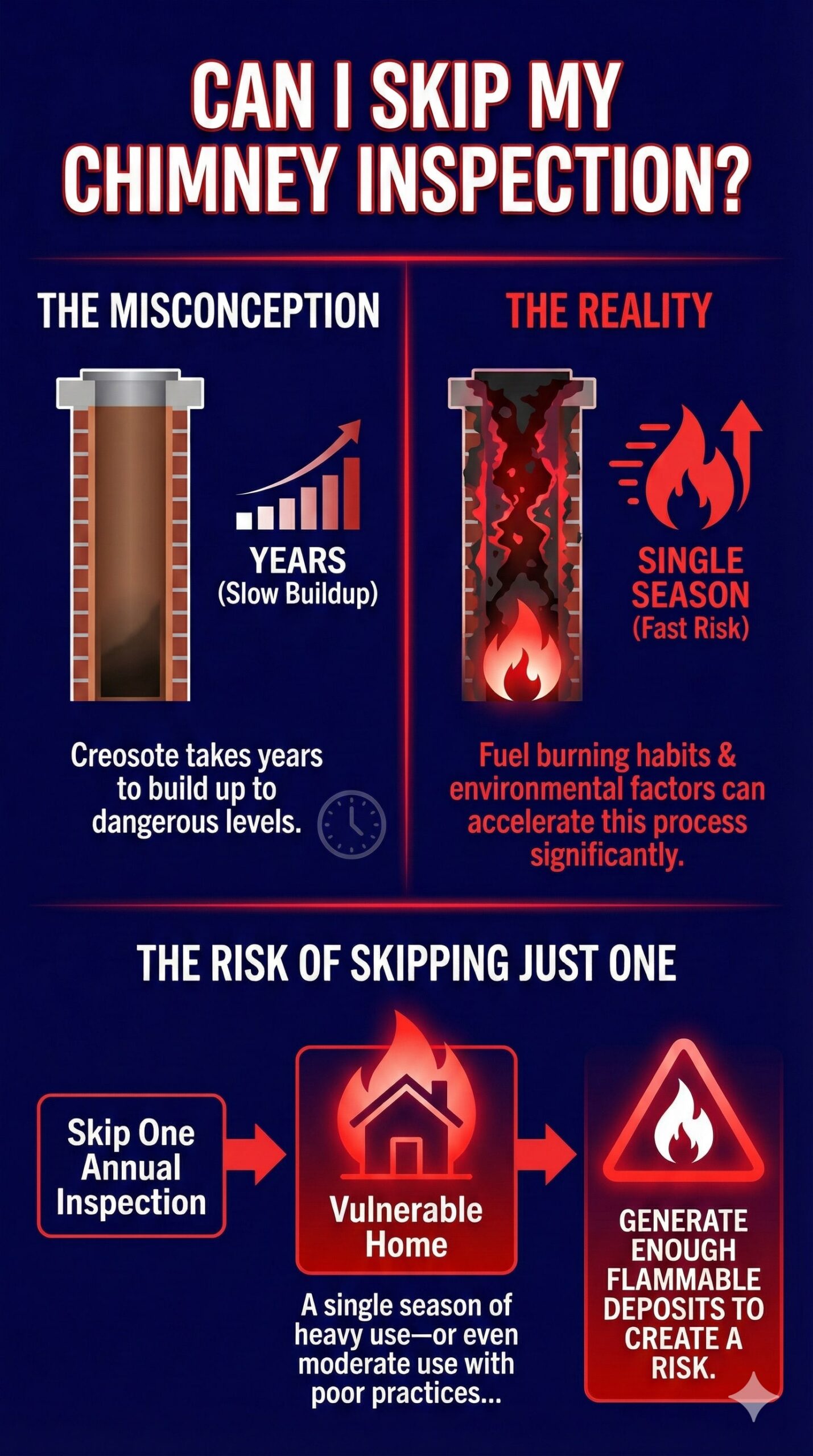
Can a Single Missed Annual Inspection Allow Enough Creosote To Ignite a Chimney Fire the Following Season?
It is a common misconception that creosote takes years to build up to dangerous levels, but the reality is that fuel burning habits and environmental factors can accelerate this process significantly. Skipping just one annual inspection can leave your home vulnerable, as a single season of heavy use—or even moderate use with poor burning practices—can generate enough flammable deposits to create a risk. Creosote is a natural byproduct of burning wood, appearing as a sticky, tar-like substance or a dry, soot-like powder. When the flue temperature drops below a certain point, these volatile gases condense on the interior walls of the liner.
Several variables determine how quickly this buildup occurs:
-
Fuel Quality: Burning unseasoned (wet) wood or softwoods with high resin content can produce significantly more smoke and creosote than seasoned hardwoods.
-
Burning Habits: Smoldering fires with restricted air supply fail to burn off combustion byproducts, leading to rapid accumulation in the flue.
-
Venting Efficiency: If your chimney is too large for the appliance or has a cold exterior chimney chase, the smoke cools faster, depositing creosote more readily.
If an inspection is missed, we lose the opportunity to catch this buildup in its early stages (Stage 1), where it is easily brushed away. Over time, and certainly over the course of a skipped season, this can harden into Stage 3 glazed creosote, which is highly combustible and difficult to remove. A chimney fire does not always manifest as a roaring, obvious event; often, they are slow-burning and explosive enough to damage the chimney liner without the homeowner immediately realizing it. By the time you schedule an inspection two years later, the internal structure may have already suffered heat damage that compromises its ability to contain future fires. Regular annual assessments allow us to monitor these levels and recommend sweeping before the volume of creosote becomes a critical threat.
Serving The Woodlands, TX: A Community We Are Proud To Call Home
The Woodlands is more than just a suburb of Houston; it is a master-planned community that has set the standard for integrating residential life with the natural world. Founded by George P. Mitchell in 1974, the area was designed to preserve the existing forest, resulting in the beautiful “invisible city” aesthetic where businesses and homes are screened by trees. We love serving this area because the residents truly care about preserving the beauty and integrity of their properties.
There is always something to do here, which makes it such a vibrant place to work and live.
- The Cynthia Woods Mitchell Pavilion: One of the world’s top outdoor amphitheaters, offering residents access to world-class music and performing arts right in their backyard.
- The Woodlands Waterway: A distinctive feature that links shopping, dining, and residential areas, perfect for a leisurely stroll or a kayak ride.
- George Mitchell Nature Preserve: This vast area offers hiking and biking trails that showcase the Texas piney woods ecosystem, reminding us why we love this region.
At Lords Chimney, we appreciate the unique architecture found throughout the villages of The Woodlands, from the estate homes in Carlton Woods to the charming bungalows in Grogan’s Mill. We understand the local climate and how the specific environmental factors here, like our humid subtropical weather and dense tree coverage,affect chimney performance.
How Do Chimneys Hold Up During Tornadoes or High-Wind Storms?
Living in Southeast Texas means being prepared for severe weather, including tropical storms, hurricanes, and occasional tornadoes. While chimneys are built to be sturdy, they are vertical structures often extending well above the roofline, making them susceptible to high wind loads. A standard brick chimney weighs thousands of pounds, but if the mortar has deteriorated or if the structure lacks proper reinforcement, high winds can cause significant damage.
During an inspection following a storm, or as a preventative measure, we look for several specific stress indicators:
- Mortar Adhesion: Wind creates lateral pressure. If the mortar joints are soft or cracking, the wind can rock the chimney back and forth. Over time, or during a sudden gust, this can break the bond between bricks, leading to instability.
- Roofline Separation: We check the flashing and the point where the chimney meets the roof. High winds can cause the chimney to sway independently of the house frame, opening gaps where water can enter.
- Projectile Damage: In The Woodlands, tree limbs are a major concern during storms. A falling branch can crack a chimney crown or knock off a chimney cap, leaving the flue open to rain and debris.
Older chimneys, specifically those built before modern seismic and wind load codes were strictly enforced, are at higher risk. They may lack vertical rebar reinforcement. If we identify that a chimney has suffered structural weakening from wind stress, we might recommend remedial masonry work or, in severe cases, partial rebuilding to ensure it can withstand the next storm season as safely as possible. We also inspect the chimney cap and chase cover to ensure they are securely fastened; a loose cap can become a dangerous projectile in high winds.
How Does a Chimney Professional Detect Microscopic Cracks in Liners That Aren’t Visible to the Naked Eye?
One of the most critical aspects of our inspection process at Lords Chimney is the evaluation of the chimney liner. The liner is the channel that carries toxic gases and smoke out of your home. If it is compromised, heat can transfer to combustible materials in the home’s framing, or carbon monoxide can leak into living spaces. While a flashlight and a mirror were once the standard tools for this job, they are insufficient for detecting the small, hairline cracks that often signal the beginning of liner failure.
To address this, we utilize advanced video scanning technology (often referred to as a Level 2 inspection). This involves lowering a specialized camera on a rotating rod down the flue.
- 360-Degree Views: The camera provides a close-up, 360-degree view of the interior walls of the flue, projecting the image onto a monitor that our technician views in real-time.
- Zoom Capabilities: We can zoom in on specific areas of clay tile or stainless steel to distinguish between surface soot and actual structural fractures.
- Documentation: This technology allows us to take still photos or video recordings, which we can review with you. Seeing the condition of the liner yourself helps you understand the urgency of any recommended repairs.
Microscopic cracks are often caused by thermal shock—a rapid change in temperature that occurs when a chimney fire burns hot and then cools down, or simply from decades of expansion and contraction. Even a small crack can widen under heat, allowing flames to reach the nearby wood framing. By using video scanning, we can identify these breaches before they become large enough to cause a structure fire. This level of detail is vital because many dangerous flaws are hidden in the “smoke chamber” or deep within the offsets of the chimney where the human eye simply cannot see from the hearth or the roof.
How Do Spring Pollen or Autumn Leaves Contribute to Blockages Compared to Winter Ice?
In The Woodlands, we deal with a specific set of debris challenges that differ from colder northern climates. While we do occasionally get freezes that can damage masonry, our primary enemies regarding blockages are organic matter like pine needles, leaves, and pollen, alongside the wildlife that thrives in our wooded environment. These blockages can be just as dangerous as ice plugs, though they act differently.
- The Pine Needle Factor: The tall pines that give our community its name drop needles year-round, but shedding can be heavy at specific times. Pine needles are highly flammable and can accumulate in the nooks and crannies of a chimney cap or on the spark arrestor screen. If this screen gets clogged, smoke cannot exit the home freely, potentially causing a backup into your living room (back-puffing).
- Nesting Material: Birds, squirrels, and raccoons view chimneys as hollow trees perfect for nesting. This material is often dry grass, twigs, and leaves—fuel for a chimney fire. Spring is a prime time for chimney swifts (a protected species) to build nests in uncapped chimneys.
- Pollen Accumulation: While pollen itself rarely blocks a flue, the sticky yellow film common in our springs can act as a binder for dust and soot, creating a layer on the cap screen that reduces draft efficiency.
Unlike winter ice, which typically melts and resolves itself (albeit causing water damage), organic blockages tend to compound over time. A layer of leaves catches more leaves, which then holds moisture, accelerating the rusting of metal damper components and caps. During our inspections, we check the termination point of the chimney rigorously. We ensure that a proper chimney cap with a mesh screen is installed to keep this debris out while still allowing smoke to escape. If you have trees overhanging your roof, we may recommend trimming them back to reduce the volume of debris falling directly into or onto the chimney system.
Can a Chimney’s Draft Be Affected by Nearby Construction (New Roofs, Additions, or Trees) Years After the House Was Built?
Draft is not just a mechanical function of the fireplace; it is a sensitive physical relationship between the air inside your home, the air outside, and the pressure differentials created by wind and temperature. Homeowners are often surprised to learn that their fireplace, which worked perfectly for ten years, suddenly has draft issues despite the chimney structure remaining unchanged. The culprit is often changes in the surrounding environment or the home envelope itself.
This phenomenon is frequently related to the “Stack Effect” and wind loading zones:
- New Construction and Additions: If a neighbor builds a second-story addition, or if you add a new wing to your own home, it can alter the wind patterns across your roof. These obstacles can create zones of high pressure that push air down the chimney (downdraft) rather than allowing it to be drawn up.
- Tree Growth: The trees in The Woodlands are magnificent, but they grow significantly over a decade. A tree that was once below your roofline may now tower over it. This can disrupt the laminar airflow required for a good draft, creating turbulence that caps the chimney with pressurized air.
- Home Tightening: Renovations that include new windows, siding, or insulation can make a home more airtight. While this is great for energy bills, it can starve the fireplace of the replacement air it needs to send smoke up the flue.
During an inspection, if you report smoking issues, we look beyond the flue. We assess the height of the chimney relative to the roof peak (the 3-2-10 rule) and relative to nearby obstacles. We might discover that the chimney needs to be extended to get back into a zone of clear airflow, or that a specialized chimney pot or cowl is needed to mitigate wind-induced downdrafts. We evaluate the entire “system,” which includes the house and its surroundings, to ensure your fireplace functions as efficiently as possible in its current context, not just how it was designed years ago.
Schedule Your Chimney Inspection with Lords Chimney Today
Your peace of mind is our priority. Living in The Woodlands offers a wonderful quality of life, and we want to ensure your home remains a comfortable sanctuary for you and your family. Whether you are noticing signs of wear, have questions about your chimney’s performance, or simply need to schedule your annual maintenance, Lords Chimney is here to help.
Our technicians are ready to provide a detailed assessment of your system, explaining our findings clearly without resorting to scare tactics. We believe that an educated homeowner is a safer homeowner. Don’t wait until smoke fills the room or a storm reveals a weakness in your masonry.
Contact Lords Chimney today to book your comprehensive chimney inspection and ensure your fireplace is ready for whatever the season brings.