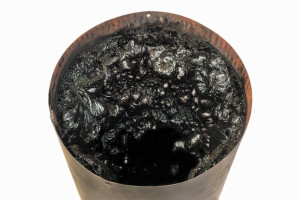
Every time you burn wood in your fireplace or wood stove, condensation forms on your chimney’s flue. That condensation forms a dark, tar-like, highly combustible substance called creosote. When creosote builds up in your chimney, it can lead to a damaging and dangerous chimney fire, or it can force carbon dioxide back into your home, endangering your family.
Creosote sweeping logs promise a solution. They claim to reduce creosote buildup in your chimney simply by burning them in your chimney. Some such logs carry the seal of approval of the Chimney Safety Institute of America (CSIA), but even the CSIA acknowledges that the logs are not a replacement for your annual chimney sweeping and inspection by a CSIA-certified chimney sweep.
Creosote sweeping logs don’t remove all creosote
Creosote sweeping logs work by sending chemicals up your chimney that react with the creosote, causing it to flake away and fall back down your chimney to your firebox, where it either burns up or can be swept away. At best, the logs only remove up to 60 percent of the creosote from you chimney over a 15-day period. That means that creosote still can build up to dangerous levels within your chimney, blocking smoke from leaving your chimney and potentially igniting a chimney fire.
Additionally, many fireplaces aren’t a straight vertical channel. That means creosote can fall to and gather on your chimney’s horizontal surfaces, where it can build up. If your chimney is a straight vertical line, the creosote that falls into the firebox can cause flare ups that can harm your hearth or someone standing near it.
Creosote sweeping logs can’t spot problems with your chimney
Your annual chimney sweeping is more than just a cleaning. Your certified chimney sweep also inspects your chimney for structural damage, water leaks, crumbling mortar, and other problems. A creosote sweeping log simply can’t help you identify and solve problems with your chimney. Missing your annual chimney inspection gives small problems, like a minor leak, time to grow into a major problem that potentially will be expensive to repair.
More importantly, your certified chimney sweep looks for problems that could lead to a chimney fire or carbon monoxide poisoning. That includes animals that have nested in your chimney or chimney fires that have gone undetected.
Schedule your annual chimney sweeping today!
While the CSIA recognizes that creosote sweeping logs can be a valuable piece of chimney maintenance, eliminating some creosote in between professional chimney sweepings, replacing your annual chimney sweeping and inspection with a creosote sweeping log is dangerous both for your home and your family. If you’re overdue for your annual chimney sweeping and inspection, call the CSIA-certified chimney sweeps at Lords Chimney. We’ll make sure that your chimney is creosote-free and ready to burn safely this winter.
If you walk down the aisles of your neighborhood big box home improvement store, you are bound to see a wide variety of products designed to help homeowners clean and maintain their fireplaces. While some of these products can be useful, they should not be used to replace regular annual chimney maintenance by a certified chimney sweep.
One such product that our customers regularly ask about are “chimney cleaning logs”. Sold for less than $20 at many home improvement stores, chimney sweeping logs advertise their ability to significantly reduce creosote buildup in the chimney. Because of this, some homeowners purchase and burn these products as their only form of chimney maintenance, patting themselves on the back for saving money on a chimney sweep.

Despite their advertising claims, these logs are no replacement for a professional chimney cleaning. Although they may be able to remove some creosote buildup, there are a number of ways that they are deficient at maintaining the health and safety of your fireplace system.
Why loosening creosote is just part of the job
The primary purpose of a chimney cleaning log is the removal of creosote; the smoke from the log loosens the creosote and causes it to fall down the flue and into the firebox, where it can be safely swept up and removed.
In theory, this is an excellent system. Unfortunately, the reality leaves much to be desired.
Most flues are not a straight vertical line between your firebox and the top of the chimney. Depending on your fireplace’s location, your flue may have one of more curves and bends in it. When this happens, the loosening of creosote by the chimney cleaning log merely causes it to fall and accumulate in the bends of the flue. This may not only block the flue, but can also create a significant fire hazard. Even fireplaces without curved flues may wind up with the majority of the creosote trapped on the smoke shelf, which can be difficult to access and clean without proper training.
A chimney cleaning log is no substitute for a chimney sweep
While a chimney cleaning log may be useful in loosening creosote, it is no substitute for the services performed by a certified chimney sweep.
“I usually tell people using one of those logs instead of having your chimney cleaned manually is like chewing Dentyne instead of brushing your teeth,” said Allan Bopp of Bald Eagle Enterprises. “It may help a little, but it’s a poor substitute for the real thing.”
Likewise, a chimney cleaning log has no way to know or tell you if your chimney is damaged in any way. There are a number of hidden issues such as cracked flue liners, decaying masonry, or damaged chimney caps or crowns that can only be spotted by a sweep during a chimney inspection. Because many of these chimney issues do not affect performance, you may have no idea there is even an existing issue.
Don’t trust the health of your chimney or the safety of your family to a $20 log bought at a big box store. Instead, have an annual chimney sweeping and rest assured that you can safely use your fireplace for the rest of the year. Contact Lord’s Chimney today to schedule an appointment!